Commentary: Faster, More Reliable Buses Are a Matter of Access
London’s slowing buses point to a wider challenge: protecting reliable, affordable access as cities manage increasingly crowded streets.
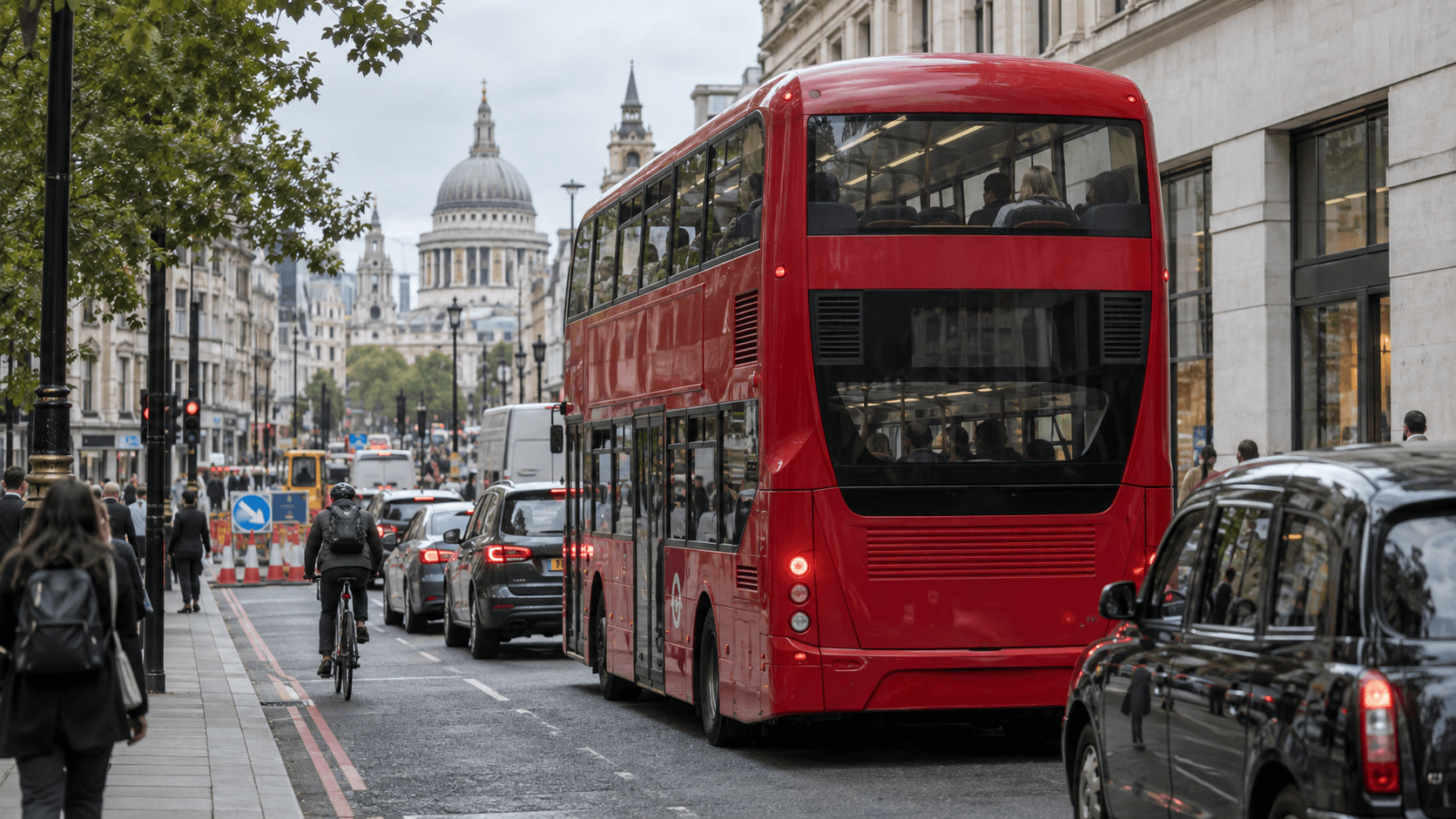
London’s buses are slowing down, and the consequences go beyond longer journeys. The Guardian’s analysis reports that 578 of the 700 routes it examined were slower in 2025 than in 2015. On the route 22, a journey to Oxford Circus took 108 minutes, with the bus stationary for 40 of them. When services become less reliable, passengers can be pushed towards other modes—or lose access to opportunities that depend on an affordable bus journey.
This is also an operational challenge. Slow journeys tie up vehicles and staff for longer, making it more expensive to provide the same frequency. If falling speeds reduce ridership and then put pressure on service levels, cities risk a cycle that is difficult to reverse. The answer is not simply to add more buses to congested streets: it is to help each bus use its time and road space more effectively.
Timetables and vehicle schedules need to reflect how travel times change across the day, and the uncertainty around those times. Treating every trip as if it takes a fixed, average duration can hide the risk of missed connections, delays cascading across a route, and vehicles returning late for their next trip. In our research, Lee et al. (2022) use time-dependent travel-time data in synchronized transit scheduling, while Gaborit et al. (2026) address bus timetable optimization with time-dependent travel-time and demand data. These approaches make the timetable problem more consistent with the conditions buses actually encounter; stochastic or reliability-aware models can further represent uncertainty in those conditions.
That calls for reliable bus priority, coordinated roadworks, and traffic signals that respond to buses, alongside careful planning for walking and cycling. These goals can be designed together. A bus network that is dependable and affordable is essential to an inclusive city—and a more efficient one.
This commentary responds to The Guardian’s visual analysis of slowing bus services in London and other global cities.

Enjoyed this post?
Follow me on LinkedIn for more insights on public transport optimization and research updates.
Follow on LinkedIn